Hugo, Where Art Thou?

Rocket, rocket, who has the rockets.

Hugo 1953 Astounding
1953 Hugo Award for Astounding Science Fiction

While writing about the Hugo situation in 1955 the other day I mentioned that Ron Smith won a Hugo in 1956 for his fanzine, Inside. This particular award is of special interest to me because as far as I’m aware the rocket Ron was awarded is the only one that has had a long-term residency in Australia. I’ve read that it was displayed in the window of Merv Binns’ Space Ago Books in Melbourne for many years after Ron Smith moved to Australia in, I think, the early sixties. I can’t vouch for that because I only managed to visit Space Age a couple of times while the store was still a going concern and was too eager to get inside to be concerned about what might be in the window display. Space Age Books is of course has long been a thing of the past now and presumably Ron Smith has passed away too so that makes me wonder what happened to his rocket? I’m assuming that when Space Age Books stopped being a bricks and mortar establishment the rocket went back to Ron (if not before that) but I can’t be certain. Hopefully somebody living in Melbourne reading this will know the answer to my query or perhaps be able to dig an answer out of Merv.

Anyway, having begun this line of thought I started to wonder if anybody has made any attempt to track down the location of the various Hugo statues that have been handed out in the past 65 or so years. I’m not thinking so much about those awarded in recent decades as I assume all those recipients are still alive and have their rockets somewhere safe. On the other hand I don’t think many of the award winners prior to 1970 other than Robert Silverberg and Harlan Ellison are still with us. Now in some cases, Robert Heinlein, Philip Dick, and Frank Herbert for example, I imagine their rockets are safe with whichever organisation their papers were donated to, but what about those authors like Mark Clifton or Eric Frank Russell who drifted away from the field before they passed away? For that matter a quick count shows 17 Professional Magazine, 16 Professional Illustrator, 21 Fanzine/Fan, 8 Dramatic, and 13 Miscellaneous Hugo Awards were handed out prior to 1970. I have to wonder how many of those rockets do we know the location of?

This strikes me as a useful project to tackle. I’m sure I’m not the only one who would be curious to know where they all those awards ended up.

Any answers?

They’d Rather Be Right

So just what happened in 1955?

Despite the battle in recent years over what works should be on the voting shortlist the Hugo awards have been relatively free of controversy since they were first awarded at the 11th Worldcon way back in 1953. Sure, I doubt there’s ever been a Hugo awarded in any category that absolutely everybody thought was well deserved. I don’t rate that as controversy though given the Hugo Awards are decided by popular vote and the disparate individuals who have voted on them each year naturally held many divergent opinions as to what constituted the best. To rate as controversy in my book there has to be some disagreement about how the awards have been run or how a particular winner was decided.

Off the top of my head I can think of only two instances that came anywhere close to plunging even a tiny slice of all fandom into war. One involved a well-known and extremely volatile author who became upset in the sixties because a particular worldcon committee was planning to not include the Dramatic Presentation Award (the committee eventually changed their minds). The other was a negative reaction in the seventies to what was seen by some as block voting for a particular fan artist (the artist decided to remove himself from future award contention).

Given all this perhaps it’s not surprising that the typical reaction to the most inexplicable TRBRHugo winner of all time, the novel They’d Rather Be Right by Mark Clifton and Frank Riley, has been more one of sorrow than anger. In the years since this novel was given the Best Novel Hugo in 1955 there have been two schools of thought in regards to They’d Rather Be Right. One is that it’s a mediocre novel that didn’t deserve to win a Hugo and the other is that it’s an underachieving novel that inexplicably won a Hugo.

Back in February of 2011 Rich Coad published Sense of Wonder Stories #5 and in that issue of his fanzine he included a cleaned up version of an e-list discussion in which the participants discussed Mark Clifton, Frank Riley and even made some attempt to explain why They’d Rather Be Right won the 1955 Hugo. It’s quite an interesting discussion despite the way (or perhaps even because) it rambles from topic to topic so if you’re interested a PDF of Sense of Wonder Stories #5 can be found on eFanzines.

Anyway, after reading that e-list discussion I did some research of my own and eventually developed a theory (oh what a surprise) which I’ll share with you here. First though I’d like to point out that while I’ll make what I think are some interesting points, these can only be considered tentative without any input from the fans who voted in 1955. Unfortunately asking those fans is a tad difficult given most of them are no longer alive enough for the likes of me to bother them. What I did instead was the next best thing and examined the historical record. In other words I went and looked through all the fanzines I have in my collection to see what was being written about They’d Rather Be Right back in the 50s.

Unfortunately my collection is not nearly so complete that I can describe the results of this search as being definitive but I do like to think that what I did discover carries some weight. For starters I was only able to find two references to They’d Rather Be Right but interestingly they’re both at odds with the more recent opinions. In Fantasy-Times #214 (January 1955) Thomas Gardener in his annual review of print science fiction describes They’d Rather Be Right as the best novel of 1954 and in Etherline #45 (1955), ‘So far, it’s excellent!’ is the opinion of Tony Santos in regards to the first instalment of the serial in Astounding. Now two positive comments isn’t a lot to go on but it still suggests the novel had a few fans back when it was first published.

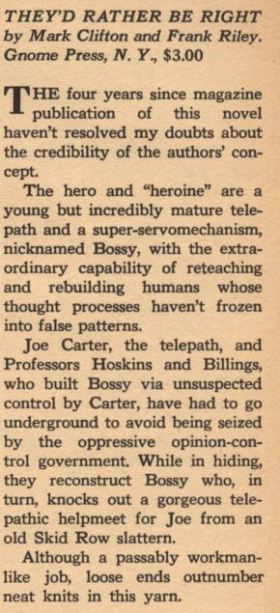
GalaxyAdmittedly, as my friend Mark Plummer has pointed out, all the professional reviewers in the science fiction magazines had something to say, but how much were their reviews duty and how much real enthusiasm? Look at the review by Floyd C. Gale published in Galaxy Science Fiction, July 1958 to the right. Hardly a ringing endorsement, is it?

Okay, so if the enthusiasm for They’d Rather Be Right melted away faster than an ice cream on Venus then why oh why did it manage to win an award?

The Sense of Wonder Stories discussion touches on three possible reasons as to why They’d Rather Be Right won despite so little evidence of enthusiasm for it. Of these I don’t find the suggestion that it was carried over the line by a block vote from the Dianetics supporters very convincing. Given Dianetics was going through a very exciting early growth spurt at this point I doubt anybody but those members who were also science fiction fans would be concerned about a fledgling set of science fiction awards. I’m willing to believe that some, if not all, the various fans who were also into Dianetics could and did vote for They’d Rather Be Right but that’s all. I’m pretty sure that if any of them had tried to organise a block vote there would be some evidence of that. I’ve seen no mention of anything like a push to secure a Hugo for They’d Rather Be Right in any fanzine I checked and I’m certain that if anybody had tried to organise such a push rumours about the attempt would be published everywhere regardless of proof.

On to the second possible reason and not having access to any issues of Astounding from the relevant period I don’t have any evidence that John Campbell actively promoted They’d Rather Be Right for the Hugo (besides which, it wouldn’t be a good look to offer too much support) but it wouldn’t surprise me in the least if he at least put in a good word for it. Even putting his infatuation with Dianetics to one side, a win for a novel serialised in Astounding wouldn’t hurt his ego. Winning awards, even vicariously, feels good and is also the sort of news an editor likes to pass on up the corporate ladder to those paying his wage. I still doubt there was anything approaching a block vote for They’d Rather Be Right but if the novel was suggested for the award anywhere it was probably in the pages of Astounding. If nothing else John Campbell would surely be happy to stop Horace Gold, his editorial rival at Galaxy and regular sparring partner, from winning with the Frederik Pohl and Cyril M. Kornbluth novel, Gladiator At Law.

This brings us to the third and most interesting suggestion, that They’d Rather Be Right gained the inside running because the overall vote was split between multiple candidates. This idea wasn’t properly pursued in the Sense of Wonder Stories discussion, mostly I think because so few possible alternatives to the Clifton/Riley novel were brought up in that discussion. However that paltry list of rivals was based upon two false assumptions, that what fans in 2005 remember as being the good novels of 1954 were the same as fannish opinion in 1955, and that voters in 1955 had a clear idea of what was eligible. This is where a little more research can make a lot of difference (even if your references are incomplete like mine).

For a start the picture I received by looking through my fanzine collection is that the field of potential candidates was much larger than assumed in the e-list discussion. During 1954/55 the following novels received positive book reviews in at least two different fanzines: Gladiator At Law by Frederik Pohl and Cyril Kornbluth, Messiah by Gore Vidal, Hell’s Pavement by Damon Knight, Against the Fall of Night by Arthur C. Clarke, I Am Legend by Richard Matheson, Fury by Henry Kuttner, West of the Sun by Edgar Pangborn, The Kraken Wakes by John Wyndham, The Caves of Steel by Isaac Asimov, and A Mirror For Observers by Edgar Pangborn. I’ve not read everything on this list but of the novels I have read there are none I would rate as unworthy of a Hugo nomination.

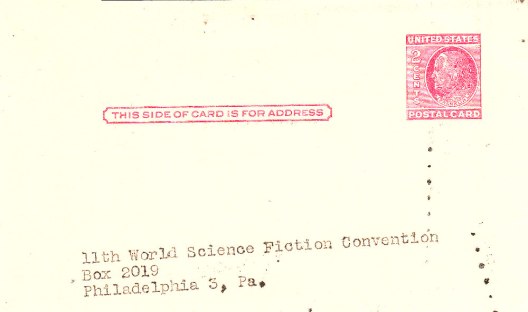
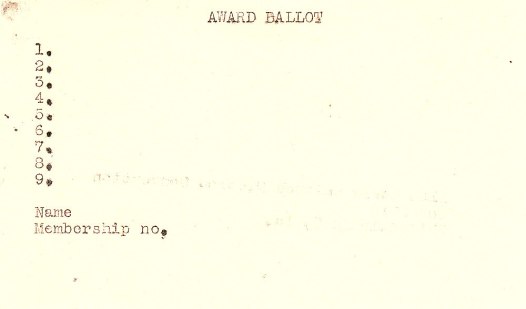
Now the key fact to note here is that until 1959 there was no filtering process in place to winnow down the number of options. It wasn’t till then that a worldcon committee decided to have voters first nominate which novels should appear on a short-list and then vote on that. Before that each committee would simply include ballots in their progress reports. The example I have here is a 1953 ballot taken from Progress Report #4 published by 11th Worldcon. By the way, the progress report I took it from was addressed to T.L. Sherred but couldn’t be delivered for some reason and was returned to sender. Thus I was the first person to lay eyes upon this ballot since it was originally sent out all those years ago (I do hope T.L. Sherred still managed to get his vote in). Anyway, as far as I can tell the 1955 ballots were essentially identical to this 1953 example:

1953 Hugo Ballot Side A


1953 Hugo Ballot Side B

Now, given such a crude system I can see how those novels listed above probably took votes away from each other. Books like Messiah or I Am Legend had no chance of winning but that doesn’t mean they didn’t receive a few votes regardless.

Now of course some of you will be falling over yourselves to point out to me that not all the novels listed above were eligible for the 1955 Hugo and you will be right. This indeed was surely part of the problem because those who voted in 1955 didn’t have access to most of the references we do. For example a quick search online shows me that The Kraken Wakes was first published in 1953 and thus was ineligible (depending on whether the Cleveland Committee counted foreign publication or not). Somebody who bought their copy of the Wyndham novel from one of the book dealers listed in Fantasy Advertiser might not be aware of this and vote mistakenly. Even if we assume every voter did a little checking and took care to not choose any clearly ineligible novels I bet errors were still made. As Mark Plummer notes in his Sense of Wonder Stories #6 letter, the period of eligibility wasn’t a calendar year but ran from August to August. That would be easy if all the above examples had seen magazine publication but as some hadn’t voters would have to decide eligibility by whatever year was quoted in the copyright notice at the front of whichever book they happened to possess. I expect the Cleveland Worldcon Committee culled out any errors they spotted since I assume they knew what was eligible and what wasn’t but that doesn’t entirely negate the problem. Every mistaken vote cast reduces the (probably) small number of votes and makes it just that much easier for John Campbell to potentially encourage the readership of Astounding to roll right over the rivals to They’d Rather Be Right.

It has become clear to me that the key to the win by They’d Rather Be Right was the mechanics of the voting system. I see that Mark Plummer also mentions in Sense of Wonder Stories #6 how Nycon II, the 1956 worldcon, wanted ‘a more representative vote’, which I suppose could mean anything but which I suspect is a tacit admission that the 1955 votes were spread between too many candidates. It’s not too hard to imagine the Nycon II Committee hearing from the Clevention Committee about how They’d Rather Be Right beat out out the likes of Gladiator At Law despite the latter being a better regarded novel because so many other books received votes. It’s also possible that some of the Clevention Committee didn’t approve of certain novels getting voted for at all, Messiah and I Am Legend come to mind in this regard, and wanted something done to discourage future voting for novels like those.

On a side note it’s worth noting that as per speculation in the Sense of Wonder Stories #5 Mark Clifton had a pretty high profile in 1955. Not only had he written a number of well liked stories but he also had an article about writing science fiction in the ninth issue of Ron Smith’s fanzine, Inside (May 1955), a fanzine to which fandom was clearly paying attention as it won the Fanzine Hugo in 1956. Oh, and according to various issues of Fantasy Times Mark Clifton attended several conventions in the mid-fifties and was announced as one of the speakers at the 1955 Worldcon. I’ve no idea if he did turn up and speak but just the news that he would be there no doubt helped ensure that nobody forgot he existed.

So let that be a lesson to you all. Regardless of how you feel about the current nominating and voting process for the Hugos you still have it better than they did in 1953. I suggest you lull yourself to sleep at night with that thought.


Author Vs Art

Can mere words catch and pin art?

As anybody who has read much of Doctor Strangemind has probably noticed I’m not exactly cutting edge. None-the-less I’m not entirely unaware of the cutting edge of controversy (especially if said edge cutting is happening on File 770). And so it is that I’m aware of how Terry Goodkind recently described his latest novel, Shroud of Eternity, as ‘…a great book with a very bad cover. Laughably bad…’ and later on claimed he disliked Bastien Lecouffe Deharme’s cover because it was ‘sexist’.

I’ve seen the cover in question and while it doesn’t wow me it doesn’t strike me as ‘Laughably bad…’ In fact my only complaint is that I’m not keen on the colour scheme which is a bit too grey and brown for my taste. As to whether the complaint of sexism holds up I’ve no idea given I’ve not read this or any other of Terry Goodkind’s novels. As such I’ll leave that question to those of you better equipped to make a case one way or the other.

What I can do is point out that author discontent with output of those artists contracted to illustrate their work is nothing new. As it so happens I recently discovered some interesting comments in regards to this very topic in Mithril #4, published by Dennis Stocks sometime in 1973. (You knew I was going to dive back into the dear, distant past at some point, didn’t you?) As a starting point for a convention panel titled SF Illustration… A Dying Art? Stocks asked various professionals for their opinions. Unfortunately while it’s clear from the responses that Dennis Stocks posed two, or perhaps three, questions I can’t find any mention in Mithril #4 as to what he asked exactly so I can’t put these comments in exact context for you. Oh well, not that it matter in regards to the first respondent, Isaac Asimov:

Heaven knows I have no views whatever on art, science fiction or otherwise.

Really? No views whatever? Okay, so I’m pretty sure this is just Asimov’s way of politely declining to be involved but none-the-less I find his wording in this sentence absolutely fascinating. This is because he didn’t make what is to me the more obvious excuse of not being qualified to comment. No, instead he stated he had no views whatever, a rather myopic claim if you ask me. Not that it clashes with my general impression of Asimov, the sheer amount of popular science writing he produced always did make it seem to me that he didn’t have much time for anything besides science. But even so I did expect Asimov to at least imply that while he didn’t know much about art he certainly knew what he liked. Is it actually possible Asimov was that indifferent to art, or was this an ill-considered statement made in haste? I’d suggest the latter except I’m reminded of the fact that the first few issues of Isaac Asimov’s Science Fiction Magazine featured photos of Asimov on the cover rather than any artwork. Hmmm…

Asimov Covers

Enough about Asimov, let’s see how L. Sprague de Camp responded:

I have no special ideas on sf illustration; it seems to me to putter along pretty much the same regardless of the New Wave. I think the New Wave is already becoming Old Wave, as such things do. Experiments are fine, but only a small minority of those in the arts have permanent effect; most don’t work and are soon forgotten.

This is the way I expected Asimov to respond, by appearing to tackle the issue but actually dodging it. I assume from the way de Camp mentioned the New Wave that Dennis Stocks asked about what effect the New Wave movement had on science fiction art. I imagine Stocks had in mind the sort of eccentric graphics the British science fiction magazine, New Worlds, became well known for after Michael Moorcock took over as editor. Unfortunately de Camp confines himself to generalities of the sort I can imagine a first year art student mouthing. Which is not entirely surprising given that by the sixties de Camp wasn’t writing or editing anything which called for any but the most obvious graphics. His non-fiction wasn’t art orientated and the Conan paperbacks didn’t need covers showing anything other than barbarians bashing each other with swords before they were good to go.

Perhaps we’ll have more luck with Robert Bloch:

About science fiction illustration being a dying art – I’d be more inclined to regard the patient as not dying but merely partially crippled. My diagnosis is as follows:

His skin – that is to say, cover illustrations in both magazines and paperbacks – has a good, healthy tone and radiates a high degree of vitality,

His insides – i.e. interior illustrations in the magazines are ailing. And have been for many a long year. Much black-and-white is crude, hastily-executed and poorly reproduced, and necessarily limited as to size by the digest format of the pages on which it appears.

Bloch then went on to suggest the latter was not due to a lack of talent among artists but a mechanical problem. I’m in agreement with Bloch in this matter, interior artwork was always going to suffer once the science fiction magazines went from pulp size (25cmx17cm) to digest (19cmx13cm). However while this change shrank spot illustrations and reduced the amount of visible detail I suspect the real problem was one of budget. The vast majority of fiction magazines were discontinued during the 50s leaving only a handful of survivors, mostly science fiction and mystery titles. Not surprisingly magazine publishers had little reason to consider these few survivors important to the company bottom line. Consequently budgets didn’t keep up with inflation and soon enough there just wasn’t enough money to spare for b&w interior illustrations of the highest quality.

I have to wonder why editors didn’t use the opportunity afforded by by the move from pulp to digest size to begin phasing interior art out entirely. They surely knew it was possible because the editors of The Magazine of Fantasy & Science Fiction had always used interior art very sparingly ever since that magazine began in 1949. However this is an easy decision for me to make in hindsight. At the time I imagine editors felt that the average reader would be disappointed if a longstanding feature like interior art disappeared. It’s also possible magazine editors felt that the interior art was a point of difference between their publications and the ever increasing number of paperbacks and thus saw the b&w illustrations as a selling point. For all anybody knew then or knows now keeping interior art did indeed help keep at least some of the magazine readership loyal.

None-the-less evolution is a thing and art has to evolve along with the rest of the world. In this case it has to asked if there is even a place for b&w science fiction art any more. If we assume that online publishing is where it’s at in regards to anything other than novels (a bit of an exaggeration I know but let’s roll with it) then why accept the budget limitations of the pulps and use anything less than full colour? While a website can afford the space to display large b&w pieces to best advantage is this a thing which people would still be interested in? This is certainly a question I would hope websites publishing science fiction have already asked themselves (perhaps they have, I don’t know enough about the modern scene to know) because I’m sure at least some artists would still like to produce b&w art on SF themes.

Bloch also wrote:

My opinions as to art used to illustrate my stories? I still admire what Virgil Finlay did on some of my yarns in the old Weird Tales – and what two friends and proteges, Albert & Flo Magarian, did in the Ziff-Davis pulps of the mid-forties, very much in the Finlay manner.

Finlay on Bloch
Fane Of the Black Pharaoh by Robert Bloch & illustrated by Virgil Finlay

My gripes are reserved for artists who obviously do not read the stories and who make their own decisions as to how the characters should look, without bothering to follow descriptions. I am not fond of abstract squiggles, nor do I care for ‘comix’ techniques which result in slapdash sketches of heroes with beetling brows and oversize jaws.

Bloch’s gripe about artists not reading his stories reminds me of a complaint made by I don’t remember who in which they claimed “Artists never read the story while blurb writers read the wrong story.” Such assumptions were often unfair to the artists though as books and magazines are produced by rigid schedule and artists weren’t always granted the time necessary to do justice to the story they were being paid to illustrate. (This is also why minimalist graphics have replaced cover art on an increasingly large percentage of books these days.)

Let’s move on to James Blish. We’ve already seen he’s the opinionated sort:

Unfortunately, I’m a poor person to ask any sort of question about art, a subject of which I have little knowledge or appreciation.

Don’t know about you but I’m sensing a theme developing here. I wonder why nobody seems game to take the ‘I don’t know much about art but I know what I like’ route?

Anyway, Blish goes on:

I’m inclined to agree with your suspicion that many New Wave stories don’t supply enough visual images to give the artist something concrete to draw. But the artists who attached themselves to the New Wave couldn’t seem to have cared less. In New Worlds many of the graphics didn’t seem to have anything at all to do with the text.

As for cover art – I get many hardcover books for review and all too often their jackets show nothing but that the artist was utterly baffled by the task. (My favourite example of this is a collection of Avram Davidson stories, the jacket for which depicted an ice-bag floating in mid-ocean – a dead giveaway of how the artist felt, but nothing to do with anything in the book). Paperback covers have generally been much better as illustrations, and I hope they last a long time.

Strange Seas & Shores
I wondered if James Blish wasn’t being a little harsh but ghad, this is uninspiring!

Ah, so Blish decided to take the ‘I don’t know art but I know what I don’t like’ route. Still, I do think he makes an interesting point in there among the general grumpiness. I think it’s fair to say that the fiction being written by most authors identified with the New Wave didn’t lend itself to striking imagery. Authors such as Brian Aldiss, J.G. Ballard, Philip Dick, the later Robert Silverberg weren’t writing material that lent itself to visual interpretation given that scenes more often than not involved groups of relatively ordinary people talking together. This actually takes me back to my earlier question about whether there is even a place for b&w science fiction art any more. In this case however it’s not a question of whether b&w art is desired when colour is so easy but if any art is desirable at all if science fiction is no longer focused on visually exotic topics.

The thing about science fiction art is that it has rarely existed as an end in itself. Most of the time SF art has been produced as an adjunct to SF stories and novels. Even when a piece wasn’t intended to illustrate a specific story it usually features objects and ideas we’re familiar with from reading those afore mentioned stories and novels.

There was a time when the art served to visualise these new concepts and add depth to them. That time is long past, so long past that what once exited us now bores. How many of us really want to see new visual iterations of the robot, the spaceship, the time machine, the alien landscape?

Okay, so the problem for visual SF seems to be that the old concepts are passe while many of the new ones are less visceral and don’t lend themselves to interesting visual representation.

I think I should end this piece with Ursula le Guin because of all the authors asked she seems to be the only one capable of being both grumpy and graceful about the art associated with her books. Other authors might like to read the following and take notes:

I know absolutely nothing about SF illustration, and yet find I have opinions about it – predjudices even – which go so far as asking, is it a dying art, or was it even born?

SF illustration. What comes to mind? Some subtle and handsome paperback book covers by the Dillons and Kelly Freas? The line drawings Gaughan did for the Jack Vance story The Dragon Masters. Tolkien’s own drawings for The Hobbit, and the beautiful dustjacket, which I think he did himself.

Then what? The illustrations to my own books, you ask about? Oh Lord. Well. You know, I trust that unless you are Harriet Beecher Stow you do not get consulted about illustrations, or book covers – or even shown them before publication, unless your publisher is uncommonly courteous? You DO know that? (I keep getting asked Why did you let them put that cover on etc, etc. Let them! Hah!)

I have been given two covers I unqualifiedly like. One is the French edition of Left Hand Of Darkness (La Main Gauche de la Nuit), which is heavy silver paper with an embossed pattern of what might be snowflakes. No picture at all. The other is the British (Hardcover – Gollancz) edition of Wizard of Earthsea, a neat Durer-like drawing in black on ochre. The original (Parnassus) and the Ace editions of the Wizard are also very handsome covers, and Ruth Robbins’ interior illustrations are elegant. The wizard on the Puffin paperback is either anaemic, or stayed too long at Oxford – I am arriving at something. I am arriving at the fact that I know what my people look like, and what their landscapes look like, and that nobody else (naturally) knows it quite the way I do – they know it their way – which is fine, so long as they keep it to themselves. But when they draw it, it looks wrong. To me. I don’t tell them that. I only tell you that. They are all talented people and they worked very hard.

But the plain silver cover with a suggestion of snowflakes still leaves the imagination free to work – which is, perhaps, the best of all?

le Guin
I strongly suspect none of the images I can find online do justice to the original French cover but hopefully this gives you some idea of why it appealed to the author.

Ambrose Bierce Buries Jules Verne

The highest powers of imagination?

I imagine most of you reading Doctor Strangemind are familiar with Ambrose Bierce. At the very least you will know he wrote An Occurrence at Owl Creek Bridge as that is widely regarded as one of the most famous short stories in American literature.

You are perhaps even more familiar with Bierce’s longer work, The Devil’s Dictionary. Certainly just about everybody I’ve ever counted as a friend has been a fan of this satirical lexicon. Even people who aren’t dyed-in-the-wool cynics are often familiar with at least some of The Devil’s Dictionary.

It’s even possible that you are familiar with the story of how Ambrose Bierce disappeared without trace in Mexico, having last been seen in the city of Chihuahua in January 1914. Some have said this mysterious disappearance was a fitting end to a life that was as epic as any of the great stories Bierce wrote. I on the other hand prefer to believe that Ambrose Bierce took the opportunity while in Mexico to travel through time and reinvent himself as Philip K. Dick, but that’s just me and I wouldn’t trust me if I were you.

However what you are almost certainly unaware of is that well before Bierce entered Mexico and legend he was a columnist for Cosmo. Yes, that Cosmo, the thick and glossy fashion magazine you’ve seen on newspaper stands and in doctor’s waiting rooms more times than you can count. However Cosmo, or to give it its current proper name Cosmopolitan has been around longer than I bet you were aware. The Cosmopolitan was first published in 1886, which would make it one of, if not the oldest newsstand magazines in the world.

However, you need not fear that Beirce wrote the nineteenth century equivalent of those sex and fashion exposes that Cosmopolitan has been more recently known for. When The Cosmopolitan first appeared it was intended to be a ‘family magazine’, in other words a magazine which was suppose to entertain and educate the entire family (assuming the family was sufficiently well-off to afford the ten cent cover price).

The Cosmopolitan
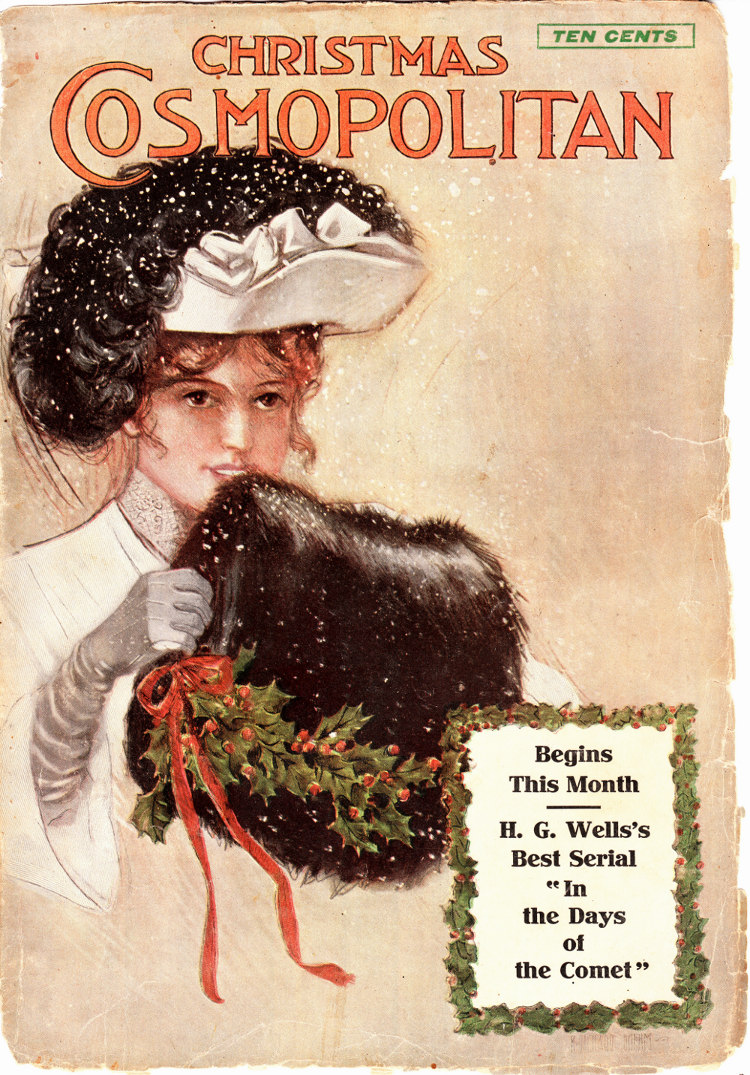
                                                                Cosmopolitan Magazine, Vol. XL No. 2, December 1905

From what I’ve read of Beirce’s column, The Passing Show, I can’t help but feel he was hired to keep the curmudgeonly old man demographic happy. This isn’t a bad thing mind you, it’s rather entertaining to read his grumbling about trends and the swatting of malefactors with his cane of good practise. This became doubly entertaining for me when I discovered him straying into one of my favourite genres of fiction.

In Cosmopolitan Magazine, Vol. XL No. 2, December 1905 he reacted to what he considered to be a hagiographic response to the death of Jules Verne:

The death of Jules Verne several months ago is a continuing affliction, a sharper one than the illiterate can know, for they are spared many a fatiguing appreciation of his talent, suggested by the sad event. With few exceptions, these “appreciations,” as it is now the fashion of anthropolaters to call their devotional work, are devoid of knowledge, moderation and discrimination. They are all alike, too, in ascribing to their subject the highest powers of imagination and the profoundest scientific attainments. In respect of both these matters he was singularly deficient, but had in a notable degree that which enables one to make the most of such gifts and acquirements as one happens to have: a patient, painstaking diligence—what a man of genius has contemptuously, and not altogether fairly, called “mean industry.” Such as it was, Verne’s imagination obeyed him very well, performing the tasks set for it and never getting ahead of him—apres vous, monsieur. A most polite and considerate imagination, We are told with considerable iteration about his power of prophecy: in the “Nautilus,” for example, he foreshadows submarine navigation. Submarine navigation had for ages been a dream of inventors and writers; I dare say the Egyptians were familiar with it before they

“heard Cambyses sass
The tomb of Ozymandias.”

As well say that in “Rasselas” Doctor Johnson prophesied the modern flying machine, although one could remember Daedalus and Icarus if one would try. When Verne took his readers to the moon, he might have shown them, carved in the bark of a lunar sycamore, the name of Lucian, with the date—for Lucian was a cautious man–”Circa A.D.CLXXXVII.” Jules Verne was a lovable character and a good writer. The world, if no wiser, is better for his having lived and written; but to compare him with so tremendous a fellow as Mr. H. G. Wells is to stray into the beaten path of literary criticism and incur the plaudits of the respectable.

For the record I will note that Mr H.G. Wells was a regular contributor to The Cosmopolitan (and was indeed present in this very issue) so it’s not beyond the realm of possibility that Ambrose Bierce was was slightly biased towards somebody who was a valuable asset to his employer. I prefer to think however that Bierce was sufficiently independent in his attitudes that he wouldn’t write the above just to please an editor or the owner.

Besides which I have to agree with him in regards to Verne. I’ve only read a couple of books by Jules Verne but what I have read (Around the World in Eighty Days and Twenty Thousand Leagues Under the Sea) isn’t what I would call ambitious. To me neither of them were novels so much as catalogues of wonders with a little plot to hold these viewings together. Jules Verne is certainly interesting from a historical perspective but that doesn’t make his fiction especially memorable.

A harsh assessment of Verne perhaps but as Bierce’s words above demonstrate, there is no romance or glory in criticism, not if you want to be honest.

Brian Aldiss & the Worst Story Ever!!!

WORST SCIENCE FICTION STORY EVER!!!

It is my impression that Brian Wilson Aldiss was generally considered to be a stern but fair elder statesman until he passed away in 2017. I, on the other hand, considered him to be far more curmudgeonly than that (he would never have a passable member of the Beach Boys for example). It also my opinion that Brian Aldiss adopted his curmudgeonly persona relatively early in his career. Oh, but Doctor Strangemind I hear you all cry, Brian Aldiss was never a curmudgeon, at least not until he was old enough to carry the title with a suitable level of gravitas! Ah ha, my poor innocent audience! You have fallen into my cunningly constructed audience trap and now while you lay squirming in the metaphorical mud at the bottom of the pit of unwarranted assumption I’ll just sit here on the lip above and tell you all about how in Australian Science Fiction Review #15 (published by John Bangsund in April 1968) that young curmudgeon, Brian Aldiss, did go so far as to accuse two fellow British authors of writing as he put it the, ‘WORST SCIENCE FICTION STORY EVER!!!’ To quote from Aldiss himself:

There was one story in particular in Authentic which, ever since I read it on its first appearance in 1954, had impressed me as reaching a really impressive level of badness. To my great delight, I found on reading it again that it has grown even worse over the intervening fourteen years. I therefore would like to nominate as the worst sf story ever published:

The Lava Seas Tunnel, by F.G. Rayer and E.R. James, (Authentic SF, edited by H.J. Campbell, Vol.1, no.43, March 1954.)

Authentic SF V1 No.43 March 1954

Now before I unleash the savage beast that was Brian Wilson Aldiss I think it only fair I let F.G. Rayer and E.R. James put forward their side of the story. For the record, according to material published in Space Diversions, the fanzine of the Liverpool Science Fiction Society, F.G. Rayer and E.R. James were in fact cousins. Francis George Rayer and Ernest Rayer James, to give them their full names, had quite a few stories published in various British science fiction magazines during the fifties. My impression is that their work was used as filler material, inserted into gaps by editors such as Herbert J. Campbell (Authentic Science Fiction Monthly) and John Carnell (New Worlds Science Fiction, Science Fantasy, & Science Fiction Adventures) when nothing more impressive was to hand.

If I am correct then this would explain why F.G. Rayer felt that the science fiction being written in his day was not up to scratch and that much of the blame for this could be placed at the feet of editors. Consider this extract from an autobiographical article by Rayer in Space Diversions #6 (April/May 1953):

The present trend in S.F. has several admirable traits and several that are deplorable, Unfortunately a writer can do very little to influence such trends – the onus rests on editorial shoulders. If the editor does not like what the writer sends in, then he does not publish it. Accordingly the writer is usually committed to write, from time to time, stories which he deduces the editor will like. These are published. The others fill the W.P.B.

Well that’s as blunt a condemnation of the editorial fraternity as you are ever likely to encounter. A cynical person might also suspect this is an attempt by Rayer to divert potential future criticism away from what he knows to be weak stories. On the other hand he might be genuinely frustrated the refusal of Bert Campbell and John Carnell to buy what he, Rayer, considers to be his best material. Without more source material to hand it’s impossible to say one way or the other.

Okay, so what were the traits in science fiction that F.G. Rayer found so deplorable? I’m glad I asked. Again from the article in Space Diversions #6:

Deplorable traits, in my view, include:- women dragged into stories for the sake of the feminine or romantic interest; pictures of the later undressed yet unfrozen in space, etc; stories based on a series of “clever” incidents which do not really integrate.

I was disappointed when I read this as given his earlier comment I was expecting a more impressive list of complains than this. While I agree that illustrating partial nudity in space is never a good thing Rayer’s first point has to me a ‘No Girls Allowed’ vibe to it and not much else while his last is insufficiently explained for it to make much sense. On the other hand his list of positive traits paints a much clearer picture:

Admired traits are:- real originality, fully reasoned and logical development, scientific premises which will stand pondering upon, and lack of superficial emotion.

At this point in the article I began to wonder if Rayer wasn’t a scientific boy scout more in tune with the philosophy of Hugo Gernsback’s explaining science through fiction than where science fiction was actually heading at the time. A idea reinforced by the following:

These feelings, strong as they are, may have arisen from the large amount of work I do on electronic equipment; here, there is always a reason, although sometimes complex deduction is required to discover it.

That seems to sum up F.G. Rayer so what about E.R. James? Well in Space Diversions #7 (December 1953) there is an article by James called Don’t Shoot the Writer which begins thus:

He’s doing his best, and –

You’ll serve yourself and him much better if, instead of saying WHAT A ROTTEN EFFORT! you try to tell him where he has gone wrong from your point of view.

It takes a keen and knowledgeable mind to criticise constructively and with proper humility, for –

Criticism is a favourite occupation of mankind (and womankind.) But it is a two edged sword. If we say a story, a piece of music or even a meal dished up by an unfamiliar cook is no good, then we are expressing a relationship, not a truth. We are saying that we cannot digest the meal, the music or the story that has been prepared and, although it may be the author, the musician or the cook, it may also be merely a statement of our own limitations.

Eating fried snails, listening to symphony music and reading science-fiction are all acquired tastes. Even reading is not a natural ability (such as eating, seeing sleeping, etc.) For we had to learn first single letters, then words and finally abstract ideas which were behind those collections of words. So you see that reading, especially in respect to a single branch of reading, i.e. S-F., is almost – – though not quite – – as much a skill as writing the words to read.

E.R. James then spends a couple more pages expounding his ideas on what an author needs to do in order to write a good science fiction story. However I don’t think we need to go into that here and now for we have what we want. Certainly I do because to me these opening paragraphs read like an attempt by E.R. James to construct a Get Out Of Gaol Free card. You don’t like one of James’ stories, ah well reading science fiction requires special skills that perhaps you don’t have.

It’s especially telling that he starts off by assuming that the disgruntled reader will respond in a singularly inarticulate manner. It ensures your argument is easier to make if you can frame the opposing argument in as crude and clumsy terms as possible. Which is why the above extract from Don’t Shoot the Writer contains no hint that a reader might follow ‘What a rotten effort!’ with an unprompted and articulate explanation as to why they found the story rotten.

I think it’s also pretty clear that James makes rather strange use of the term ‘relationship’ because he actually means opinion but doesn’t want to come out and write that because it will likely be a red rag to a bull in regards to the audience of this article. What James is suggesting in this camouflaged manner is that any negative comment is merely an opinion and as such can be dismissed because opinions aren’t the same as facts. This is indeed true but what James is trying to hide is that a negative comment can contain both opinion and fact.

All in all F.G. Rayer and E.R. James come across to me like characters in a Simon and Garfunkel song:

We are but two sad boys,
Though our stories always sold.
We did trade our souls to editors,
The purveyors of deplorable, heed not their promises.
All lies and jests…
Still a man hears what he wants to hear,
And disregards the rest.

And now at last we come to The Lava Seas Tunnel, featuring the combined writing talents of F.G. Rayer and E.R. James. So perhaps you would like to know what this story, sorry ‘WORST SCIENCE FICTION STORY EVER!!!’ is about. So, a plot summary is clearly in order.

The Lava Seas Tunnel opens in the cockpit of some sort of boring machine. We learn that it’s commanded by a Steve Martel who is nervous about the forthcoming operation due to a previous accident. Martel shares the cockpit with an unnamed communications officer with whom he is annoyed because the fellow arrived late. Below, in the nose of the machine is an observation officer named Hedgersley and the engine room is crewed by somebody called McGilligan. What then follows is:

They begin boring.

The machine halts due to a fault in the thermostat.

After two & a half hours work this is fixed and they begin again.

They bore for hours but then the machine breaks down again due to a blocked nozzle.

Martel and the communications officer are knocked out by the sudden stop but Martel recovers and pulls the communications officer to safety and in the process discovers it’s his son, Dave, in disguise. Martel is annoyed that Dave has snuck aboard but there is little he can do about it now.

Anyway after sixteen hours work the blocked nozzle is fixed and Martel decrees a six hour break before they begin boring again.

Martel discovers McGilligan has exited the machine and it busy digging diamonds as big as eggs out of the tunnel wall. There is a confrontation, McGilligan produces a gun and locks the rest of the crew in the store room and makes his escape with the diamonds in a life-balloon.

It’s during this confrontation and subsequent incarceration that we learn that the Earth has run short of coal and oil and needs to tap into lava deep inside the planet in order to generate power. Nice to learn at last why we’re all here.

Once the remaining crew break out of the store room they discover McGilligan has smashed the instruments in the control room. An hour is required to repair everything sufficiently to begin boring once more.

Eventually they stop for a sleep break but Martel wakes up to discover he has been tied to his chair. Hedgersley then informs him that he works for a foreign country that wants to see this project fail. Hedgersley then escapes in the second life-balloon. Martel eventually escapes from his bindings just in time to discover Dave recovering from a blow to the head. He also discovers that Hedgersley has jammed the release mechanism of the one remaining life-balloon, trapping father and son forever.

The two of then make one last attempt to break through to the sea of lava the world so desperately needs access to. And they do! Success! But oh no, the borer is slipping down towards the molten sea where neither it or the remaining crew can survive. But fear not, Dave reveals that he also noticed the jammed release mechanism and repaired it. The two men scramble into the cabin of the life-balloon and float up the tunnel as the borer falls to its doom. Presumably they reach the surface and everyone receives their just deserts. The end.

So, Brian Wilson Aldiss, what’s your initial reaction to The Lava Seas Tunnel?

Anyone who has followed the careers of these two authors as closely as I have will know how exquisitely poor they can be alone; together, they are exquisitely bankrupt.

To be honest, Brian, I think exquisitely incomprehensible would be a better description. Almost nothing described in this story makes any sort sense. Consider the following account of how the boring machine works:

Turbines whined and flames glowed redly through the observation ports of indestructible mica. Below them, the rock made molten by the huge flame projectors was being sucked away. It would be ejected upon the walls of the boring, giant sprocket holes being formed in it as it solidified, so that the machine could wind itself back up to the Earth’s surface.

Okay, so two points I’d like to query about this astonishing process. First of all how is there an open tunnel behind the borer? Surely once the rock melted by those huge flame projectors is sucked back behind the machine it would solidify into the same amount of mass as it had before being melted? Secondly, just how are those giant sprocket holes being formed, hmm? You know, coming from somebody who claimed he wanted to see ‘scientific premises which will stand pondering upon’ this gibberish is especially embarrassing to F.G. Rayer. Don’t you agree, Brian?

This total blindness to any sort of technological probability extends to the equipment of the machine itself. The escape apparatus consists of three inflatable balloons, which are suppose to drift up the tunnel the boring machine has made! The machine is not refrigerated; it has “heat-batteries” instead. Nor is it equipped with an intercom; Hedgerley’s voice comes “over the reproducer”.

Yes, Brian, those life-balloons worried me too. At first glance the balloon idea is a potentially clever low-tech solution to the problem of how crew members might return to the surface in an emergency. However, as with all the technology mentioned in this story, there is no detail explaining how it works so I’m left high and dry. Given from what little the reader is told I’m guessing that the tunnel created by the borer is relatively smooth-walled (apart from those inexplicable sprocket holes that is) so in theory a balloon might float up the shaft unimpeded like a car in an elevator. By all rights however conditions outside the borer should be extremely hot so the balloon would need to be constructed of heat resistant material and filled with incombustible gas for it to be viable and we never learn if this is so.

You’re also probably right about the borer not being refrigerated but we can’t be absolutely certain of that because while the authors make it clear that the temperature inside the machine is being regulated they are once more singularly vague about how this is achieved. For example they do mention heat-batteries but give absolutely no indication of what heat-batteries do.

What actually worried me more is the inconsistent attitude of the authors to heat in general. Look at how they have McGilligan exit the machine in order to collect diamonds. By this point the borer was deep within the Earth’s crust and surely even back in the early fifties it was clear just how hot the inside of that tunnel would be. According to a video I watched recently about the Kola Superdeep Borehole in Russia the temperature in that shaft reaches about 180C/356F at 12,262 metres/7.6 miles. Inside the tunnel in this story the temperature would surely be at least that high, and that’s not taking account of the heat generated by the rock melted by those flame projectors mentioned earlier. It rather makes a mockery of the idea that the molten rock would cool enough to be used as the walls of the shaft, or that anybody could exit the borer without being cooked alive. Apparently the temperatures inside the shaft were determined by the author’s convenience rather anything approaching physics.

In regards to the internal phone system, Brian, I think your complaint is nitpicking given it’s initially described as an internal phone. I’m willing to accept that the device is also known both as a phone and a reproducer and is sometimes called the latter. For what it’s worth the reproducer was one of the less confusing devices mentioned since its purpose in quite clear, unlike the heat-batteries or the radar scanner.

Okay, so on to another of Brian’s major points:

For the assumption behind the story is that things are really desperate on Earth: all supplies of coal and oil have run out, and the only thing that will power Earth’s “enormous industrial machines” is lava. The authors literally have not heard of nuclear or hydro-electric or solar power.

If I was to be more generous than Brian I would assume this story was set on an alternative Earth where the power of the atom had not been discovered. However, even if I did the authors this favour the fact remains that the story is so bereft of context that I’ve no idea if it’s suppose to be set in our future or an alternate history. The authors included no details about the world outside of the borer, we never even learn who Martel and his crew work for or how the project is being funded. All we have are three surnames; Martel, McGilligan, Hedgersley, and one first name in Dave. I dare you to pinpoint their country of origin from those scant details. Given all this I can’t do them the favour of assuming they live in a world where nuclear power hasn’t been discovered.

Besides which, even if I did give the authors the benefit of the doubt in regards to nuclear power there still remains the vexed question of hydro-electric or solar power. Indeed I would go one further than Brian and mention the absence of wind, geothermal, and tidal power generation. How can it be that none of these things rate a mention in The Lava Seas Tunnel? One sentence gentlemen, one sentence was all that was needed to explain how the various renewable sources of power combined were nowhere near enough to keep Earth’s industry functioning. Add a second sentence and tell us how much cheaper lava power would be in the long run. We might not believe it but at least it would be possible to believe the pair of you have some understanding of how power is generated.

It would also help to explain why Hedgersley’s foreign employers were so keen to sabotage the boring project. Perhaps then these unnamed foreigners could be worried that this project would allow the unnamed backers of the boring project to hold the world to ransom and become Earth’s stern and unforgiving masters. Doing that would have given the story a little of the colour it so desperately needs.

Anything else, Brian?

The authors’ reluctance to come to grips with anything that might be termed a fact means that they do not tell us at the beginning that this is a four-man boring machine. This, coupled with their haziness of characterization, causes difficulty for the reader. It seems as though the machine is swarming with crew – ratings maybe, since the only people mentioned are officers.

Well, Brian, while I didn’t find the number of crew members confusing as you apparently did I still think you hit the nail on the head with your point about the authors not wanting to come to grip with facts. If The Lava Seas Tunnel can be said to have any defining characteristic it’s an air of purposeful vagueness. No attempt is made to ensure anything in this story seems real which guarantees there is no sense of consequence. It doesn’t matter what happens to any of the characters because they aren’t people and it doesn’t matter what happens to the world because it doesn’t exist.

Was Brian Wilson Aldiss right to label this as the ‘WORST SCIENCE FICTION STORY EVER!!!’? I can’t say because there is a lot of competition for that dubious honour. However, given the comments quoted at the beginning of this article, I would nominate F.G. Rayer and E.R. James as the most delusional science fiction authors ever.

And that’s saying something!

A.E. Van Vogt – In the Beginning

Not every origin story needs to be revealed.

Recently I responded to an article about pseudonyms written many years ago by Anthony Boucher. In it I mentioned that A.E. Van Vogt as an example of an author didn’t care to be associated with a certain genre. I made this claim because I had a memory of reading a piece by him in which he admitted to writing for true adventure style pulps but giving no details.

Since then an old friend of mine, Denny Lien, who knows more about such matters than I ever will, pointed me to a page on the van Vogt website that actually reprints one of these stories and gives some background on how it was rediscovered. So it turns out I was wrong about him writing for the true adventure pulps. What he actually wrote apparently were true confession type stories which is about as far from his later science fiction in theme and style as you could get.

When I read this example of van Vogt’s true confession work I have to admit I didn’t find it terrible as I suspected it might be. It probably helped that the story isn’t a long one, or that to my eye at least it appeared to be an attempt by van Vogt to parody the short stories of O. Henry. I think it was a parody attempt rather than simple imitation. Certainly lines such as this suggest parody to me:

It was the old Ted, exasperatingly smug in his knowledge of her, incurably romantic about himself and probably already planning to commemorate the occasion by writing one of his happy-ending stories, in which he would be the forgiving and ill-used hero.

Not perhaps the most on-target dart tossed at O. Henry’s sentimental tendencies but van Vogt’s ire was in the right place.

So I can see why van Vogt would want to avoid revealing his literary past to his science fiction audience if it’s all like this. While not terrible it’s clearly a bit too twee and small in scale for the author of epics such as The Weapon Shops of Isher or The World of Null A to admit to.

Timbered Walls a Sanctuary Makes

Ghosts, not as omnipotent as we thought apparently.

Lee Brown Coye
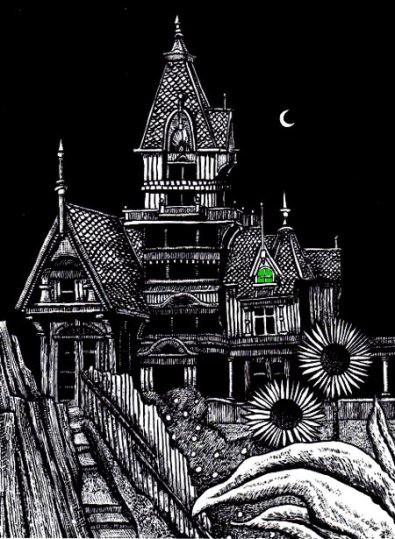
                           A Haunted House by Lee Brown Coye

A while back I was listening to Amanda Vickery’s BBC Radio series, A History Of Private Life when in the second episode she delivered a rather interesting aside. (I’d offer you a link but the series is no longer available on the BBC iPlayer.) While talking about the tradition of houses being a barrier against witches, wizards, demons, and other terrors of the night she mentioned that the ability of ghosts to walk through walls is a modern conceit. According to Amanda Vickery traditionally the denizens of the supernatural world could no more ignore the barrier of a stout wall than the those of us living in the physical.

Not surprisingly my ears perked right up at this claim. My assumption was that the ability to pass through solid objects has always been a basic supernatural right. Any talk to the contrary interested me greatly as it suggested I had been operating on a false assumption all these years.

Given my impression that Amanda Vickery is somebody who does her homework and that A History Of Private Life is a well researched series I don’t want to dismiss this claim out of hand. Still, I’m not willing to accept her claim without giving it some thought. However, something to keep in mind before I go any further is that Amanda Vickery was talking specifically about England, or at most the UK so folktales from elsewhere can’t be taken into account as that wouldn’t be fair to her claim.

The the first point to make then is that ghosts are a quite different category of the supernatural to witches, wizards, demons and frequently operate under different rules. This definitely muddies the waters of debate quite a bit. For example many traditional tales of haunting involve the ghost being located within the walls of a building which at first glance would seem to knock Vickery’s claim right on the head. Not necessarily though if we assume (for the sake of argument) that a ghost comes into being in whatever place had greatest significance for the individual when they breathed their last. By that logic a ghost might first appear either inside or out but is trapped on the side of the wall it finds itself on. Since uncertain memory suggests to me that in traditional ghost stories it was not entirely clear whether ghosts did pass through walls or simply approach some physical barrier and disappear right before it (often in order to indicate a hidden object that needed to be found before the ghost could rest) rather than actually pass through the wall this seems a distinct possibility.

On the other hand uncertain memory also suggests that traditional tales usually imply that ghosts are limited in their ability to roam anyway which makes the entire question of stout walls being a barrier rather irrelevant. Witches wizards, and demons being alive (arguable in the case of demons I know, but at least they’re something other than dead) are free agents who can travel the countryside. That being so folklore requires some means to limit their ability otherwise they become invincible which wouldn’t do at all. So tradition dictates witches wizards, and demons can’t just kick in your nice stout door and have their way with you at will. This same logic explains why in folktales vampires have to be invited inside before they can enter your house for a biting good time. If vampires could simply flutter through any open window on whim it would be fangs for the memories as far as the human race was concerned. A haunted house on the other hand is a limited threat because the majority of traditional ghost stories do imply the ghost is more or less fixed in one place. I’ve encountered more than one such tale in the protagonist is told not to go to a certain place at a certain time because the ghost is a danger and of course they can’t resist going to that place at that time only to be found dead the next morning. By this logic then the only way a ghost becomes a serious threat is putting yourself in harms way. Ghosts should not be a serious threat unless a rich relative demands in their will that you spend the night in a haunted house before inheriting their fortune.

Anyway, what the above suggests to me is that if ghosts traditionally could not pass through solid objects it was because they had no need to. This in turn means that on one hand Amanda Vickery is very likely correct in her claim but on the other hand she’s probably only correct because there was no reason for them to do so rather than because ghosts were specifically barred from passing through walls.

However, this is not necessarily the end of the matter because while the majority of ghosts don’t appear to be free-range there are some which are allowed surprisingly large territories. The Wild Hunt for example is sometimes depicted as being composed of the dead and as far as I know the Hunt can pretty much go where it likes. This only counts in folktales where the Wild Hunt is described as spectral rather than Fey Folk as fairies are entirely different piece of folklore with an entirely different set of rules (and Amanda Vickery never defined their house entering status, mostly I suspect because I don’t recall a folktale in which one of the Fey Folk wanted to enter a human abode).

Another example would be the many tales of headless horsemen and other vengeful ghosts haunting ancient roads. In these stories the ghost is always difficult to escape because they aren’t confined to a specific area once they materialise (though their initial appearance does seem to be limited to a specific place). In which case it would make sense for folklore to balance this ability for such ghosts to roam widely by placing the same limitation upon them as stopped witches, wizards, and demons from forcing their way into the family home.

So I’m inclined to agree with Amanda Vickery but with the qualifier that her comment is only relevant to a minority of ghosts.

The Notorious Bert I. Gordon

“…repeat to yourself “It’s just a show, I should really just relax…”

Before you read any further there is something I think you need to know about me. I’m a fan of Mystery Science Theater 3000 and have been since sometime in 1994 when a friend living in the USA began sending me episodes (and I will be eternally grateful to Lucy for her part in circulating the tapes). Now I know some of you will be shocked by this revelation and the rest of you will be confused. For the latter group I suggest you go here.

Okay, so now we all know that MST3K is a TV show that revolves around showing a movie of dubious quality and providing a humorous commentary which, in this, the future world of today, is a little thing we like to call riffing. I doubt riffing is a new or revolutionary practise, I imagine people have been moved to talk back to the screen ever since the very first bad movie was shown in front of an audience. I even have evidence of a primitive form of movie riffing happening at a British science fiction convention. Consider this quote from Walt Willis writing about the Loncon in Quandry #22 (edited by Lee Hoffman, August 1952). This particular Loncon (there has been more than one SF convention called this) was held 31 May & 1 June, 1952 and in London of all places:

The final event was a showing of Metropolis, which in a way was the best part of the official programme. This was because there was no incidental music to drown fan comment on the action, some of which was brilliant. Dan Morgan shone especially. When the hero suddenly mimed exaggerated alarm the way they do in silent films and dashed madly for the door Dan remarked “FIRST ON THE RIGHT”. That started it and the whole worthy but rather dull film was enlivened by a ruining commentary from the audience which I wish I had space to quote…

By the way, I’m pretty sure the Dan Morgan mentioned here was the soon to be published author Dan Morgan.

However, to get back on topic, as far as I’m aware MST3K was the first ever attempt to use riffing as the centre piece of a TV show. Earlier attempts to reuse old film and TV footage for comedic purposes usually involved removing the original soundtrack entirely and replacing it with new dialogue and sound effects. This is clearly a different thing entirely, though when done well it can be extremely funny.

However, while I’ve been a long-standing fan of MST3K (or a MSTie if you prefer) my taste in bad movies doesn’t entirely match majority opinion. The bottom line is that for me the added humorous commentary can’t make a badly plotted and slow moving movie watchable. For example, according to The Den of Geek the top three MST3K episodes as voted on by fans of the show are 1. Manos: The Hands of Fate, 2. Space Mutiny, & 3. Mitchell. I’ve watched all three of these episodes once but despite several attempts I simply can’t sit through any of them a second time. Once was possible only because the novelty value helped me through but once that was gone…

Instead my favourite episodes include (to select a few from the Den of Geek list) 9. Cave Dwellers, 27. Warrior of the Lost World, 44. Deathstalker and the Warriors From Hell, 57. Attack Of The Eye Creatures, & 65. The Magic Sword. None of these are good movies, all of them deserve to be on MST3K but still each of them have enough plot to maintain forward momentum. In these films there’s always something happening, it may be a stupid thing but at least the stupidity is driving the plot forward.

Then there are the marginals, those MST3K episodes which use almost interesting films, the sort of you can watch more than once so long as you can jump over the slower bits. Many, but not all, of these involve monsters for some reason (don’t ask me why, there are some things best not pried into). Good examples of these, again taken from the Den of Geek list, would be 16. Hobgoblins, 68. Wild, Wild World of Batwoman, & 84. Godzilla Vs. The Sea Monster.

Curiously I see The Giant Gila Monster, an episode I’ve never had the will to watch all the way through, not only made the Den of Geek list but also placed a very respectable 43. I am amazed at this given the far more entertaining Earth vs the Spider didn’t make the list at all. Now Earth vs the Spider isn’t up there with the better MST3K episodes but I would still rate it a watchable marginal on a level with Godzilla Vs. The Sea Monster.

Gene Roth
             Gene Roth – Sheriff to the film cowboys.

Personal taste to one side Earth vs the Spider has two features that in my opinion set it above The Giant Gila Monster. The first being the superlative performance by Gene Roth as Sheriff Cagle. By the way, if he looks at all hauntingly familiar to you it will be because Gene Roth also played Sheriff Kovis in Attack of the Giant Leeches, another watchable but not great Roger Corman film featured on MST3K. Gene Roth had a long and varied career but I think it’s fair to say he was never better than when he had to play a law enforcement officer who through no fault of his own was forced to work a beat that was a week away from the nearest source of doughnuts. In The Giant Gila Monster Fred Graham did his best as Sheriff Jeff but how could he compete with the man both Bert I. Gordon and Roger Corman knew was sheriff material?

Even better than Sheriff Gene Roth however was the shameless plug director Bert I. Gordon gave his own work. About fifty minutes into Earth vs the Spider faux-teen Carol (played by June Kenney) phones Mike (played by Eugene Persson) her faux-teen boyfriend. Mike is working at his father’s movie theater so naturally the action twice passes by a large poster advertising The Amazing Colossal Man, a film directed by (surprise, surprise) Bert I. Gordon. Then when we see Mike on the phone he’s standing in front of a selection of lobby cards framed on the wall, lobby cards that look suspiciously like they might be advertising the work of a certain Bert I. Gordon. (I can’t be totally certain about the lobby cards however as my eyesight is no longer sharp enough to read those tiny, blurry titles.)

Okay, I can let the above pass because the scene is set in a movie theater, a place where you would expect to see posters and lobby cards. True, the plot didn’t need Mike’s father to own a theater and the poster and lobby cards could just as easily been for a fake movie but I can accept the possibility that Gordon did what he did simply because it required no effort. However, when faux-teen Mike tells Carol he doesn’t want to leave the cinema and take her to the cave they had visited earlier in order to recover a bracelet any doubt I had about the director’s motives were blown away. And just why didn’t young Mike want to live up to his earlier promise and do the decent thing for his girl? Well, in his own words, “Carol, not today, my dad just got in a new picture and I haven’t even seen it yet, something about puppet people, sounds pretty wild.” That wouldn’t be Attack of the Puppet People (directed by Bert I. Gordon) you’re talking about by any chance, would it Mike? Not only that but as he says this our faux-teen glances in an exaggerated manner at those lobby cards which leads me to suspect they might indeed be advertising Attack of the Puppet People. Oh my! Bert I. Gordon! You certainly deserve to be called the Notorious B.I.G. for so blatantly suggesting that a teenage boy (even a faux one like Mike) would be better off watching one of your movies than making his girlfriend happy. Even Quentin Tarantino has never gone so far as to suggest his films are a superior choice to normal human relationships (at least don’t I think he has, but it’s hard to be sure with a hot bag of nuts like Tarantino).

So there you have it, the Bert I. Gordon get out of gaol free card. Any time somebody wants you to do something you don’t wanna just tell them you really, really have to watch a Bert I. Gordon film (your choice of title) because you hear it’s really, really wild. Try it tonight, you’ll thank me in the morning.

Gene Roth 2
       Who wouldn’t want to see Gene Roth play the space Sheriff of Nottingham?

Anthony Boucher & I Discuss Pseudonyms

Their names are Legion, for they are many.

According to The Illustrated Book Of Science Fiction Lists (edited by Mike Ashley for Virgin Books in 1982) E.C. (Ted) Tubb has 45 pseudonyms credited to him, Robert Silverberg is well behind with 25, Henry Kuttner further back yet with 18, while Cyril Korthbluth trails with a mere 13.

I suspect that in this, the future world of today, the question the above information raises is not why so many pseudonyms but why any at all? I know that when I were a lad it was a given that authors used pseudonyms all the time while we, their audience, didn’t but nowadays it seems to be very much the opposite. So yes, I can understand why the above numbers might seem inexplicable to many of you.

So why were authors fond of pseudonyms once upon a time? Luckily for us editor, author, and co-founder of The Magazine Of Fantasy & Science Fiction, Anthony Boucher, decided to offer some explanation in Rhodomagnetic Digest #2, published by George Blumenson in August 1949 for The Elves’, Gnomes’ & Little Men’s Science-Fiction Chowder & Marching Society. Boucher was certainly qualified to write on this topic since his real name was William Anthony Parker White. As to why somebody who had been given so many names already decided to add Anthony Boucher and H.H. Holmes to the collection, well according to William Anthony Parker White he used these pseudonyms for reasons 2 & 5 as explained below.

So now on to Mr Boucher and why authors so often used something other than their real names back in the day:

The reasons for adopting a pseudonym are many, and the simplest is that the author’s proper name may be unsuitable as a by-line. Anyone christened Hieronymus Zuckerswilling is obviously going to adopt a pseudonym; and so is anyone unfortunate enough to have a perfectly good name which somebody else has already made famous. A pseudonym is convenient , too, for avoiding the multiple by-line of a collaboration; Ellery Queen and Q. Patrick are good examples. And occasionally a woman adopts a male name to avoid anti-feminine prejudice, though more often, like C. L. Moore, she uses initials.

But we’ll concentrate here, not on the cases in which all of an author’s published work appears under a pseudonym, but on the cases, especially frequent in fantasy fiction, in which the same writer’s stories appear under two or more different by-lines. The principle reasons for this are:

1.  To distinguish two different types of work — for instance fiction and serious articles; or terror and humour.

2.  To keep series characters and events straight – so that all the stories under one name are part of the same series.

3.  To please different publishers — so that each has an ‘exclusive’ name author.

4.  To differentiate markets — for instance, one name for slicks and another for pulps; or a separate name for selling rejects to poor markets without damaging the well-established name.

5. To use when two stories appear in the same issue of the same magazine — as frequently happens when an author is selling heavily to one market.

6. Allied to 5. is the problem of the ‘house name’ — a name owned by the publisher. This is legitimate enough when, as in The Shadow, a freelance series is supposedly all written by the same non-existent ‘author’. It’s more questionable when the house name is simply stuck on a story of any type by anybody when there are two by one writer in the same issue.

7. The oddest pseudonym-reason I know occurred in this wise: an extremely prolific writer was turning out so much that his own by-line had become almost meaningless; you never knew whether it indicated a small masterpiece or a trashy quicky. He adopted a pseudonym and henceforth published all his really good stories under that name, with the result that the pseudonym came to be one of the top names in the field, while the original by-line usually connotates a competent hack story.

Much as I find the above interesting I do think Boucher rather stumbled out of the gates with the idea that anybody’s given name might make for an unsuitable byline. Is Hieronymus Zuckerswilling any more unprintable than G. Peyton Wertenbaker, A. Hyatt Verrill, or Clare Winger Harris? The latter three all managed to have stories published with their own fairly elaborate names intact. I suspect that those same editors would do the same for Hieronymus Zuckerswilling just so long as he was giving those editors the sort of material they wanted.

On the other hand his point about the potential confusion of a well-known namesake being an irritant an author might want to avoid is a good one. I know for a fact that while I don’t hate the pop music of Ed Sheeran or Justin Bieber if I was a published novelist who shared a name with either of them it would annoy me to have strangers mistake who wrote my golden prose. I’d have to use a more obscure name like John Lennon if that were the case.

I’ll also concede that collaborative authors using a pseudonym is tidier than multiple bylines (and also avoids the question of whose name should be first) and that there was a time when some editors, and some women, preferred the anonymity of male sounding pseudonyms, or at least the anonymity of initials. As recently as 1969 Ursula Le Guin reluctantly agreed to use the byline U.K. Le Guin when her story Nine Lives appeared in the November issue of Playboy.

However in regards to the meat of Boucher’s article, the seven principal reasons he lists, I am confused. Boucher was an editor and author for a long time so he obviously encountered many authors using pseudonyms for the reasons he gives but that doesn’t mean most of those reasons make much sense to me (even Boucher himself seems to question how some magazines used  house names).

Take the idea that an author would use a different name for a particular series of stories. Imagine for a moment that you’re the young Isaac Asimov, a rising star within the pages of John W. Campbell’s Astounding. Your stories, in particular those about robots, have proved quite popular, but now you have a new series in mind. This series will chart the rise and fall of a galactic wide empire and span millennia and it’s the grandest thing you’ve ever attempted. So of course you decide it can’t appear under your own name, it needs to be associated with a unique byline. So you ask Campbell to ensure that every Foundation story appears in Astounding as by Gaston Feeblehare. Does that make sense to you? It doesn’t to me! Why give up the hard won selling power of your name in order to alert readers that a particular story belongs in a particular series. I’m pretty sure the average reader would be able to work this out for themselves. On the other hand Boucher does point out that Robert Heinlein used pseudonyms as a means to keep series characters and events straight though not in the way Boucher explained. According to the Science Fiction Encyclopedia Heinlein had his non-Future History stories published under the Anson MacDonald, Lyle Monroe, John Riverside, and Caleb Saunders bylines so clearly there are cases where my brand name argument fails to apply (I still think it’s a silly idea).

Using different names for different types of work also seems to me to be giving up the hard won selling power of your name for no real gain. Would it really affect an author’s ability to sell factual articles if they were known for their science fiction? If E.E. ‘Doc’ Smith or Robert Heinlein had decided to write articles for the hot rod magazines back in the fifties would the editors insist they do so under a pseudonym? This seems unlikely to me, indeed I suspect said editors would want to be associated with previous success by mentioning Smith and Heinlein’s science fiction careers.

Just as an aside Asimov did use the pseudonym Paul French when he wrote his Lucky Starr series of SF juveniles. At first this seems like a perfect example of an author doing exactly as Boucher explained. However it seems Asimov wasn’t inexplicably refusing to use his name power for no reason. According to various sources he decided to hide behind the name Paul French because there was talk of the Luck Starr stories being turned into a TV series and Asimov apparently had no faith in the potential quality of such a series. Since he didn’t want the hard won selling power of his name sullied by the production values of a fifties TV show made for children Asimov hid his involvement behind the Paul French pen name in order to pull an Alan Smithee before that became a thing.

If however two different editors wanted an exclusive name for their magazines then why would an author argue with them? Did it make sense for editors to do this back in the day? It doesn’t seem like it would be worth the bother but then again I’m not such an expert on editorial practices back then that I can dismiss the idea out of hand. From the point of view of the author though I would think the right idea was take the cash and hope both markets prove successful. I know if somebody offered me enough money I’d be happy to write as Gaston Feeblehare (don’t get any ideas though, it would have to be a LOT of money).

That gets us to the different names for different markets category and this one makes more sense to me but for a reason Mr Boucher doesn’t mention, snobbery. From various comments I’ve read here and there it seems to me that some authors and editors didn’t care to be associated with certain genres. Examples of this include two different judges keeping secret what they did in the evening because at the time writing fiction wasn’t considered respectable; Fred Pohl mentioning in passing how none of the Futurian editors liked sport but all were editing sports pulps that he was very careful to not name any titles; A.E. Van Vogt admitting to writing for true adventures style pulps but giving no details. (For the record I can’t quote sources for any of this because these are things I read years ago when I didn’t realise I would need to quote them in a future article.)

In which case it wouldn’t surprise me if at one time the slick magazines preferred to hide authors who had made their names in the pulps behind pseudonyms. Slick magazines were printed on high-quality glossy paper and were designed to be bought by well to-do readers. As such the editors and publishers preferred to avoid association with the less refined pulp magazines. The pulps were printed on cheap, rough paper (hence the name pulp) and had a far more garish image. (However by the 50s magazines like Saturday Evening Post and Mademoiselle did relaxed their standards sufficiently to allow certain authors with pulp histories, such as Ray Bradbury and Robert Heinlein, to grace their pages.

I also have the distinct impression that while many authors were willing to write fiction in more than one genre not all of them wanted this to be known. If this is correct then using a pseudonym for stories in the little favoured genre is a quick and easy solution to the situation. (Unfortunately I can’t think of any concrete examples to back this up so for the time being this will have to remain an unproven assertion.)

What is however easily provable is the use of the ‘house name’ in certain magazines. Again this is a practise the benefits of which I don’t always understand. Yes, as Boucher noted, it does make sense if multiple writers are using an intellectual property owned by the publisher. The Shadow wasn’t just a magazine published by Street & Smith, they also laid claim to the character and everything about him so while various authors contributed stories to the series the lead ‘novel’ was always published under the Maxwell Grant pseudonym.

However the other usual claim is that house names were used to conceal the fact that an editor might be using more than one story by a particular author in the same issue of a magazine. And again as Boucher noted, this is a rather questionable practise. I suppose it’s possible in such a situation an editor might arbitrarily assign a house name if there isn’t time to ask an author what pseudonym they would prefer (or because a particular editor doesn’t care what mere authors want). However disguising multiple stories by a single author in one issue doesn’t explain those occasions when editors used house names indiscriminately. For example at both Standard Magazines (Space Stories, Startling Stories, Thrilling Wonder Stories) and Ziff-Davis (Amazing Stories, Fantastic Adventures) multiple authors were published under the same house names. If there were good reasons for this practise I’m yet to discover them. I can’t see how the indiscriminate us of house names benefited anybody seeing as such a system surely didn’t encourage any of the authors concerned to submit their best. Anything published this way under a house name isn’t going to improve an author’s reputation, and indeed isn’t likely to harm it, so authors have every incentive to send to such editors the stories they can’t sell elsewhere. Mystifying.

That leaves me with only the last item on Boucher’s list to comment on. So who was the extremely prolific author who was writing so much of such varying quality that his name had become almost meaningless? It was Henry Kuttner and according to Anthony Boucher the pseudonym he began to publish all his best work under was Lewis Padgett. Which is true as far as that goes but it was extremely remiss of Boucher to not mention most, if not all, the Lewis Padgett stories were written to one degree or another in collaboration with C.L. Moore. I can’t believe Boucher didn’t know about the collaborative nature of this pseudonym so again I’m mystified as to why he didn’t mention it.

Now before I finish here is Will Fitzgerald Jenkins on why he used the name Murray Leinster. This appeared in Fantasy Magazine #26, published by Julius Schwartz in October/November 1934 and I think it lends some credence to my snobbery theory:

Murray Leinster, my pen name, was adopted because somebody flattered me. My first published stuff was sold to Smart Set when that magazine was edited by Nathan and Mencken (and some said God was a member of the firm) and was quite the hottest of the intellectual magazines. At least it seemed intellectual then.

Since they bought the first stuff I was ever paid for, I naturally thought them persons of brilliant discernment and wisdom. And being just out of short pants, I could be kidded. I think it was Mr. Nathan who suggested that I ‘save’ my own name for Smart Set and use a pseudonym for inferior publications.

At least Mr Nathan didn’t suggest Jenkins call himself Gaston Feeblehare (what a stupid name).

Ursula Le Guin & Her Elusive Hugo!

It all began with a hot tip from Perry Barr of Ace Boops.

Goodbye Ursula. The heavens above were never so full that we won’t miss your bright particular star.

And now for my favourite Ursula Le Guin letter, one which highlights the two things I like best in an author, a lack of pretentiousness and a sense of humour. The following letter appeared in Philosophical Gas #2, published by John Bangsund in October 1970. The Hugo in question was awarded to Ursula for The Left Hand of Darkness at Heicon ’70, the worldcon held in Heidelberg, Germany in August of 1970. I assume the rocket was accepted on Ursula’s behalf by Terry Carr of Ace Books (which would explain a lot). Other than that I don’t think there is anything I can add except I hope the following makes you smile, at least for a moment:

‘We were over in our cabin in the Coast Range on Slick Rock Creek, well insulated from Civilisation by a lot of fir trees and bears and stuff, and it was about 8 a.m. and there was a knock on the door. Mr Smith from up the road. Mr Smith has a telephone, and he had a message for us – from our daughter, he thought they said. As our eldest daughter is 13 and was reading Mad Magazine right in the loft at the time, we were confused, but staggered up through the bears and firs and called the number he had taken down. It was Virginia Kidd in Pennsylvania, who had forgotten the 3-hour time difference between Pennsylvania and Oregon but had a hot rumor that my book had won the Hugo. So I called a friend in Portland who was coming to visit in a few days to stop by the house and pick up any telegrams that might be lying about. Which they did; so about 5 days after the Heidelberg meeting was over I got three, hand-delivered telegrams, one of which said Congratulations your novel won Hugo award Terry Car Ac Books, one which said Congratulations your novel won Hugo award Perry Barr Ace Boops, and one which said Congratulations sinister Hugo more please John Bangsund. It was that one which made the day. I didn’t believe the others, but you clinched it. When I get news from North Carlton, Victoria, I believe it. It was a lovely thing to do, and I do thank you.

Alan Nourse has the actual, physical Hugo; apparently Terry Carr (or Perry Barr, of Ace Boops) gave it to him, saying “You can give it to her, Alan, you both live on the West Coast”, which is perfectly true, only he lives in North Bend Washington and I live in Portland Oregon, but what are these little provincial differences? Oh, are you from America, do you know my friend James Peebles? Well, when Mr Nourse called tonight I asked him just to put some fuel in the rocket and fly it down. He said he’d thought of that. We don’t seem to have thought of any other solution yet. But that’s all right. I don’t need a bronze rocket. I have your telegram.’